


If you’re working with electric motors, generators, or transformers, you’ve probably heard of the coil span factor—also known as the pitch factor or chording factor. This small but powerful concept plays a big role in how efficiently your machine generates voltage.
By tweaking the coil span, engineers can influence not only voltage levels, but also waveform quality, machine size, and energy losses. In this guide, we’ll break down what coil span factor means and why it matters in real-world applications.
What Is Coil Span Factor?
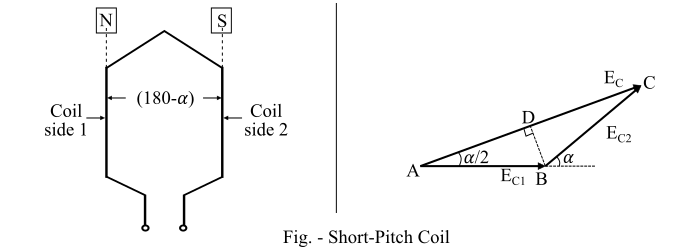
The coil span factor (KC)—also called the pitch factor or chording factor—measures how effectively a coil generates voltage based on its span. It’s defined as the ratio of voltage produced by a short-pitch coil to that of a full-pitch coil. The formula is:
KC = cos(α / 2)
Where α is the angle by which the coil span is shortened in electrical degrees.
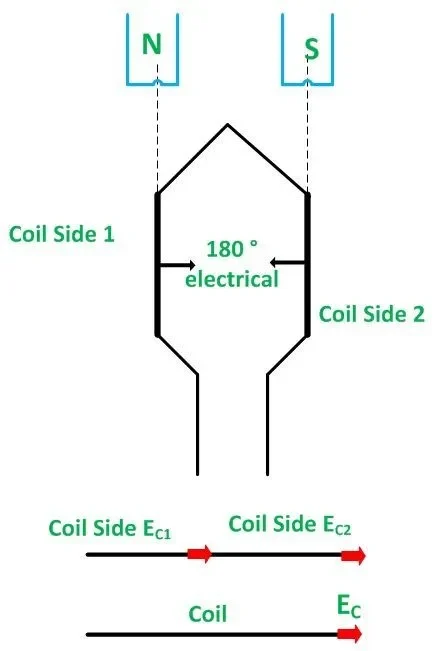
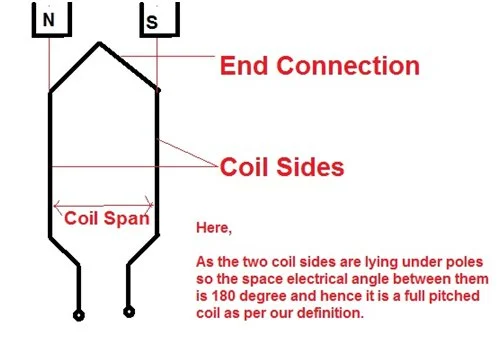
A full-pitch coil spans 180° electrical, so KC = 1—meaning both coil sides generate in-phase voltage for maximum output. In contrast, a short-pitch coil (less than 180°) results in KC < 1, as the voltages from each side are slightly out of phase.
Why does this matter? A smaller KC slightly reduces voltage output, but it can also improve efficiency by reducing harmonic distortion and saving copper wire. That trade-off often makes short-pitch coils a smart design choice in modern electrical machines.
Full-Pitch vs. Short-Pitch Coils
Full-pitch coils produce maximum voltage by keeping both coil sides in phase, while short-pitch coils reduce voltage slightly but improve waveform quality and save materials.
Choosing between them depends on whether output voltage or efficiency and compact design is the priority.
Benefits of Short-Pitch Coils
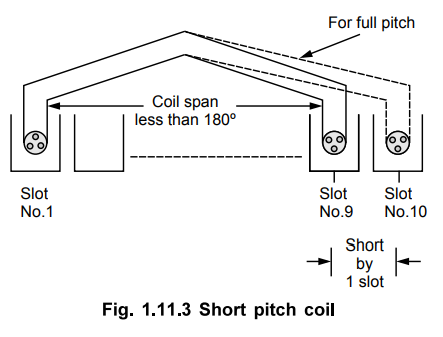
Using short-pitch (chorded) coils comes with several advantages:
Saves copper wire: Shorter coil ends reduce the length of wire needed, cutting material costs.
Reduces harmonic distortion: Helps produce a cleaner sine wave by minimizing unwanted harmonics.
Improves high-frequency performance: Ideal for machines operating at higher frequencies or speeds.
Enables compact design: Shorter coils allow for more space-efficient winding layouts.
Lowers copper losses: Reduced wire length means slightly less resistance and heat generation.
Trade-off: These coils generate slightly lower voltage than full-pitch coils because the coil sides are not perfectly in phase.
Applications in Electrical Machines
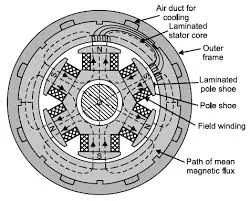
The coil span factor plays a key role in how modern electrical machines are designed and perform. Here’s how it impacts various applications:
Generators: Engineers use short-pitch coils to reduce the overall size of the machine while maintaining decent efficiency. This is especially useful in compact or portable generators.
Motors: The coil span affects starting torque, winding layout, and overall motor performance. Chorded coils help optimize motor size without severely compromising output.
Alternators: Adjusting the coil span helps balance voltage regulation and maintain symmetrical magnetic fields, ensuring stable power delivery.
Transformers: Short-pitch coils minimize core losses and can enhance performance in high-frequency transformers or compact layouts.
Stator and Rotor Windings: Using the right coil span improves electromagnetic compatibility (EMC) and reduces losses, helping machines run cooler and more efficiently.
How to Choose the Right Coil Span

Choosing the right coil span depends on what you’re building and your design goals. If your priority is maximum voltage output, a full-pitch coil (180° electrical) is your best bet. But if you’re working with limited space or aiming to reduce harmonic distortion, a short-pitch coil can be more practical.
Shorter coils also mean less copper usage, making them ideal for compact, cost-sensitive designs. Always weigh the trade-off between voltage efficiency and physical constraints when deciding.
FAQs on Coil Span Factor
1. Why is the coil span factor always less than 1 for short-pitch coils?
Because the voltages on each coil side are not in phase, their phasor sum is less than their arithmetic sum, resulting in KC < 1.
2. What is the typical coil span for a 4-pole, 48-slot motor?
It’s usually 120° electrical, providing a balance between voltage output and harmonic reduction.
3. How does coil span affect voltage waveform quality?
Short-pitch coils help improve waveform purity by canceling harmonic components, resulting in a smoother sine wave output.
Conclusion

 English
  Spanish
  Russian
  Italian
  German
  Chinese