


Toroidal coils are essential components in various applications, including transformers and inductors, where they help improve performance by reducing electromagnetic interference.

However, manually winding toroidal coils is a complex and time-consuming task.
That’s where a DIY toroidal coil winding machine comes in—offering a solution that ensures consistent, accurate, and automated winding for better results every time.
Components Required for the DIY Toroidal Winding Machine

Before diving into the build, let’s take a look at the essential components you’ll need for your DIY toroidal coil winding machine.
- Arduino Controller
- Stepper Motors
- DC Motors
- Rotary Encoder & LCD Display
- Timing Belts & Pulleys
- Spool Ring & Holders
- Miscellaneous
Step-by-step guide for custom coil winding
Step 1: Design the Frame and Assembly

Start by designing the base frame, roller holders, and ring assembly using plywood and aluminum profiles.
Ensure the frame is sturdy and stable to support the movement of the motorized components.
The frame’s design should allow easy adjustments for the winding process while holding the toroidal core securely in place.
Step 2: Set Up the Stepper Motors and DC Motors

Mount the stepper motor and DC motor securely to the frame.
The stepper motor controls the toroidal core’s rotation, while the DC motor drives the spool.
Use NEMA 17 stepper motors for precise movement control. Wire both motors to the Arduino for seamless communication and accurate movement adjustments.
Step 3: Install Timing Belts and Pulleys

Attach the timing belts to the motors and spool ring, ensuring the pulleys are aligned for smooth movement.
Adjust the belt tension to avoid slippage during operation.
The right tension is key to maintaining accurate wire winding, so make sure the belts are neither too tight nor too loose.
Step 4: Implement the Arduino Controller
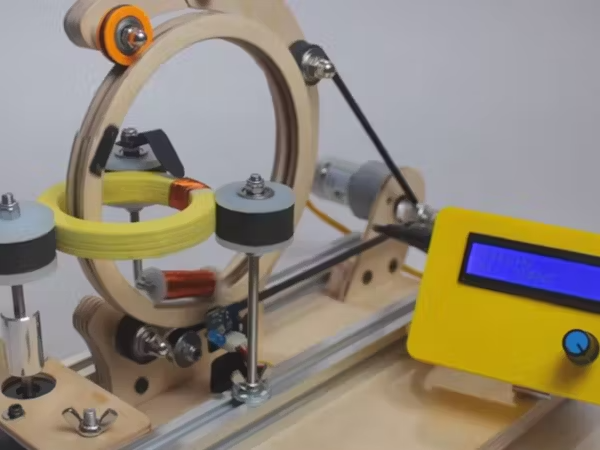
Wire the Arduino to control both the stepper and DC motors. Program the Arduino to set the number of turns, wire density, and rotation speed through an LCD display.
This step allows you to control every aspect of the winding process, making it customizable to your needs.
Step 5: Testing and Calibration
Test the machine by running a few cycles of wire winding.
Adjust motor speeds and check the wire placement to ensure consistent winding.
If issues like slipping belts or misalignment occur, make necessary adjustments to motor speed, pulley alignment, and belt tension for smooth operation.
Step 6: Final Touches and Safety Considerations
Once the machine is running smoothly, add protective covers around moving parts and rubber feet to keep the machine stable.
Ensure all components are safely secured, and double-check wiring to prevent accidents.
This step ensures your DIY toroidal winding machine is safe, efficient, and ready for use.
Common Mistakes to Avoid

Even a well-built DIY toroidal winding machine can underperform if a few key details are missed. Here are some common pitfalls to watch out for:
Skipping wire tension calibration can lead to uneven winding and wire breakage.
Over-tightening belts may strain the motor and reduce its lifespan.
Neglecting safety features like proper insulation, covers, or emergency stops increases the risk of accidents.
A bit of planning and double-checking goes a long way in building a safer, smoother-running machine.
FAQs
1. What is a toroidal coil used for?
A toroidal coil is commonly used in applications like transformers, inductors, and chokes, where its shape helps reduce electromagnetic interference and improve energy efficiency.
2. How do you wind a toroidal coil?
To wind a toroidal coil, pass the wire through the center of the core, wrap it around the outside, and return it through the center again. Repeat this process to build up the turns.
3. What is the advantage of a toroidal coil over a regular coil?
Toroidal coils offer better performance due to their symmetry, reducing leakage flux and electromagnetic interference, which makes them ideal for use in sensitive electronic devices.
Conclusion

Building a DIY toroidal coil winding machine is a rewarding project that simplifies the winding process, ensuring precise and consistent results.
Automation makes coil production easier and more efficient, offering high-quality output tailored to your needs.
Ready to start? Use this guide to create your own machine, and feel free to contact us for more tips or custom solutions!

 English
  Spanish
  Russian
  Italian
  German
  Chinese