


Ringkernspulen are widely used in applications such as transformers and inductors, where their design helps reduce Elektromagnetische Interferenz (EMI) and improve overall performance.

However, manually winding Ringspulen can be a complex and time-consuming process.
A DIY toroidal coil winding machine offers a practical alternative, helping achieve more consistent and accurate winding while reducing the need for manual work.
Erforderliche Komponenten für die DIY-Ringwickelmaschine

Before starting the build, let’s review the essential components you’ll need for a DIY toroidal coil winding machine.
- Arduino Controller
- Schrittmotoren
- Gleichstrommotoren
- Drehgeber und LCD-Anzeige
- Zahnriemen und Riemenscheiben
- Spulenringe und -halter
- Miscellaneous Components
Schritt-für-Schritt-Anleitung zum individuellen Spulenwickeln
Schritt 1: Rahmen und Montage entwerfen

Begin by designing the base frame, roller holders, and ring assembly using Sperrholz und Aluminiumprofilen.
Make sure the frame is sturdy and stable enough to support the movement of the motorized components.
The design should also allow for easy adjustments during the toroidal coil winding process while keeping the Ringkern securely in place.
Schritt 2: Einrichten der Schrittmotoren und Gleichstrommotoren

Securely mount the stepper motor and Gleichstrommotor to the frame.
The stepper motor controls the rotation of the Ringkern, while the DC motor drives the spool.
For precise motion control, use NEMA 17 stepper motors. Connect both motors to the Arduino controller to coordinate their operation and adjust movement as needed.
Schritt 3: Zahnriemen und Riemenscheiben einbauen

Connect the timing belts to the motors and spool ring, making sure the pulleys are properly aligned for smooth operation.
Adjust the belt tension to prevent slippage during operation.
Proper belt tension is essential for genaue Drahtwicklung. Make sure the belts are neither too tight nor too loose.
Schritt 4: Implementieren Sie den Arduino-Controller
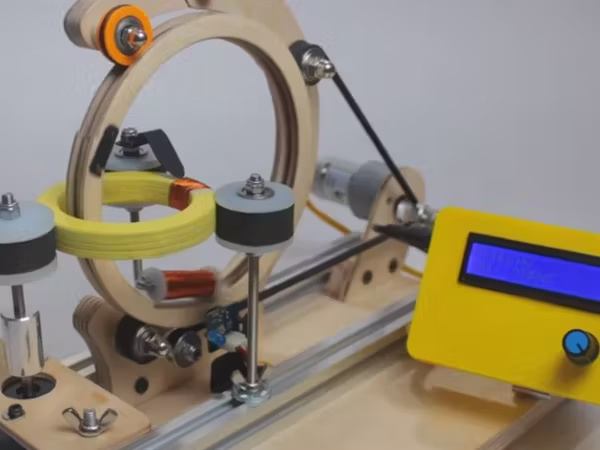
Connect the Arduino controller to both the stepper motor and DC motor. Program it to adjust the Anzahl der Umdrehungen, wire density, Und rotation speed through the LCD display.
This setup allows you to adjust key winding parameters and customize the toroidal coil winding process to suit your needs.
Schritt 5: Testen und Kalibrieren
Run several wire winding cycles to test the machine’s operation.
Adjust the motor speeds and inspect the wire placement to ensure consistent winding.
If you notice issues such as belt slippage or misalignment, adjust the motor speeds, pulley alignment, and belt tension as needed to achieve smooth operation.
Schritt 6: Letzte Handgriffe und Sicherheitsüberlegungen
Once the machine operates smoothly, install protective covers around moving parts and add rubber feet to keep the machine stable.
Make sure all components are securely fastened and double-check the wiring to help prevent accidents.
These final checks help ensure your DIY Ringwickelmaschine is safe, stable, and ready for use.
Häufige Fehler, die Sie vermeiden sollten

Even a well-built DIY toroidal winding machine may not perform as expected if certain details are overlooked. Keep these common pitfalls in mind:
Kalibrierung der Drahtspannung überspringen can result in uneven winding and wire breakage.
Zu straff gespannte Riemen can place extra strain on the motor and shorten its service life.
Vernachlässigung von Sicherheitsfunktionen ,such as proper insulation, protective covers, and emergency stops, can increase the risk of accidents.
Careful planning and thorough checks can help you build a safer machine and achieve smoother operation.
FAQs
1. Wofür wird eine Ringspule verwendet?
A Ringspule is commonly used in transformers, inductors, and chokes. Its ring-shaped design helps reduce Elektromagnetische Interferenz (EMI) and improve energy efficiency.
2. Wie wickelt man eine Ringspule?
To wind a Ringspule, pass the wire through the center of the core, wrap it around the outside, and pass it through the center again. Repeat this process until the required number of turns is reached.
3. Was ist der Vorteil einer Ringspule gegenüber einer herkömmlichen Spule?
The symmetrical design of Ringspulen helps reduce magnetic flux leakage and electromagnetic interference. These characteristics make them suitable for use in sensitive electronic devices.
Abschluss

Building a DIY toroidal coil winding machine can simplify the winding process and help achieve more precise, consistent results.
Automation can make Ringspule production easier and more efficient, with output tailored to your specific needs.
Ready to get started? Follow this guide to build your own machine, or Kontaktieren Sie uns für weitere Tipps oder individuelle Lösungen!

 German
 English
 Spanish
 Russian
 Italian
 Chinese