


Gleichstrommotoren are widely used in elektrische Fahrzeuge, Haushaltsgeräte, Industriemaschinen, Und Robotik. They are valued for their sanfte Geschwindigkeitsregelung, high torque output, Und fast startup performance, making them a reliable choice for applications that require efficient and responsive motion control.
This article covers the Haupttypen von Gleichstrommotoren, their working principles, and common applications, helping you understand how to select the right DC motor solution for your specific project needs.
Brushed DC Motor Basics

They are einfach, kostengünstig, Und easy-to-control DC motors, making them a popular choice for Elektrowerkzeuge, Robotik-Bausätze, Und ältere Geräte. However, because the carbon brushes wear over time, bürstenbehaftete Gleichstrommotoren require regular maintenance and are generally less efficient than newer brushless motor designs.
For a budget-friendly DC motor that is easy to wire, simple to control, and practical for basic applications, bürstenbehaftete Gleichstrommotoren remain a reliable choice. Their straightforward design makes them suitable for projects where cost and ease of operation are key priorities.
Bürstenlose Gleichstrommotoren (BLDC)
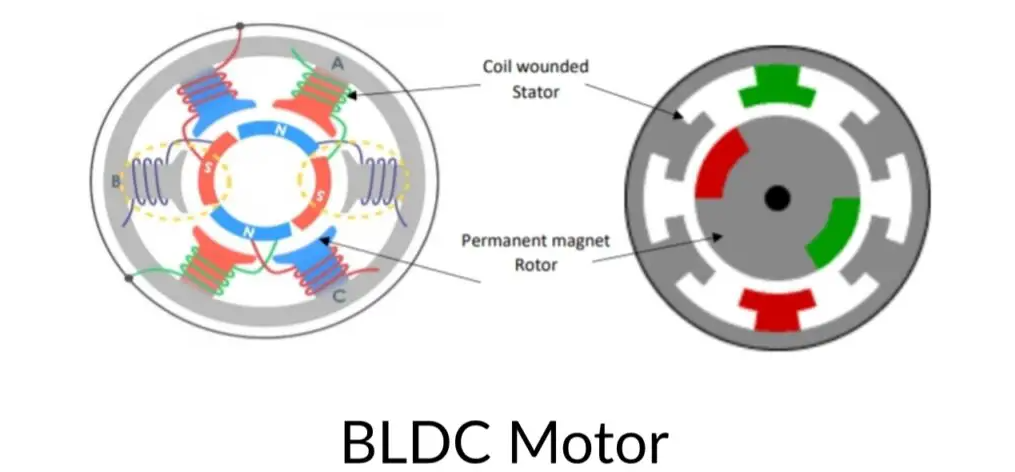
Im Gegensatz zu Bürstenmotoren bürstenlose Gleichstrommotoren (BLDC) verwenden elektronische Schaltungen instead of Bürsten to switch current. They rely on Hall-Effekt-Sensoren oder ein motor controller to manage Kommutierung, timing, and speed control, enabling smoother and more efficient operation.
The result is a Gleichstrommotor that runs leiser, Kühler, Und länger. BLDC-Motoren bieten höhere Effizienz, lower maintenance requirements, and improved performance at high speeds. They are widely used in applications such as Drohnen, Elektrofahrzeuge (EVs), Fans, Und moderne Geräte.
The main drawback is that BLDC-Motoren require an additional motor controller,which increases the complexity of the overall system.However, the advantages of höhere Effizienz, lower maintenance, Und better performance often make them a worthwhile choice.
PMDC Motor Benefits & Limits

Permanentmagnet-Gleichstrommotoren (PMDC) use built-in Permanentmagnete In der Stator instead of electromagnetic windings. This creates a einfach, compact DC motor design that is well suited for applications where space is limited.
Sie bieten gutes Anlaufdrehmoment and perform efficiently under low to medium load conditions. This makes PMDC motors a common choice for applications such as Autowischer, kleine Pumpen, Spielzeug, Und Medizinprodukte. However, they are less suitable for heavy-load applications and may overheat when operated beyond their limits..
Für leicht Und portable applications, PMDC motors offer a strong balance between Leistung, kompakte Größe, Und design simplicity, making them a practical choice for space-limited systems.
Wound-Field DC Motor Types
Im Gegensatz zu permanent magnet DC motors, Wicklungsfeld-Gleichstrommotoren verwenden Drahtspulen to generate the magnetisches Feld. This design provides greater Kontrolle Und Flexibilität, as motor performance can be adjusted based on how the Feldspulen are connected.
Gleichstrommotoren der Serie

In series DC motors, Die Feldwicklung Und Ankerwicklung are connected in series, creating sehr hohes Anlaufdrehmoment. This makes them suitable for heavy-duty applications such as Kräne Und elektrische Züge. However, they can run at excessive speeds under no-load conditions, making them less suitable for light-load applications.
Shunt-Gleichstrommotoren

Compound-Gleichstrommotoren

Armature Control Explained

Armature-controlled DC motors werden häufig verwendet in automatische Systeme, laboratory equipment, and applications where präzise Geschwindigkeitsregelung is more important than high torque output. Their ability to provide accurate speed adjustment makes them suitable for systems requiring fine control.
Specialized DC Motor Types

Am meisten Gleichstrommotoren fall into gebürstet, bürstenlos, oder wound-field categories, but some specialized DC motor types are designed for unique or high-demand applications. These motors offer specific performance advantages for projects with more specific requirements.
Geschaltete Reluktanzmotoren (SRM)
These use magnetic reluctance (the resistance to magnetic flow) to generate rotation. They have no permanent magnets or rotor windings, making them durable and cost-effective. SRMs are suitable for Hochgeschwindigkeitsanwendungen wie zum Beispiel Fans Und compressors, but they can produce more noise and require advanced motor controllers.Homopolarmotoren
Dies ist einer der einfachsten Arten von Elektromotoren, mit einem einzelnes Magnetfeld und ein konstanter Gleichstrom to create motion. They operate without a commutator or electronic switching, as current flows through a conductor that rotates around a magnet. While mainly used for wissenschaftliche Experimente Und educational demonstrations rather than practical machines, they provide a basic understanding of DC motor principles.
DC Motor Selection Guide

Use this quick guide to match the right DC motor type to your project priorities:
Benötigen Sie ein hohes Anlaufdrehmoment?
Wählen Sie ein Reihen-Gleichstrommotor oder Compound DC motor. They are well suited for heavy loads and applications requiring strong startup performance.Sie möchten eine stabile Geschwindigkeit bei unterschiedlichen Belastungen?
Betrachten Sie eine Shunt DC motor oder BLDC-MotorSie bieten consistent speed control for applications that require reliable motion.Suchen Sie nach einem wartungsarmen Produkt?
Brushless DC motors (BLDC) are a strong choice. Without Bürsten, they reduce wear and require less maintenance for longer service life.Sie haben ein knappes Budget?
Wählen Sie ein Bürsten-Gleichstrommotor. It offers a simple design, affordable cost, and easy control for many basic applications.Arbeiten Sie mit begrenztem Platz?
Permanentmagnet-Gleichstrommotoren (PMDC) provide a kompakte Größe and efficient performance, making them suitable for portable devices and space-limited systems.Benötigen Sie erweiterte Steuerung oder variable Geschwindigkeit?
Betrachten Sie eine BLDC-Motor oder Armature-controlled DC motor. Both offer improved speed adjustment and more flexible performance control.Arbeiten Sie in rauen oder Hochgeschwindigkeitsumgebungen?
A Geschalteter Reluktanzmotor (SRM) can be a suitable option when Haltbarkeit Und high-speed operation are important.
By focusing on key factors such as Drehmoment, Geschwindigkeitskontrolle, Effizienz, kosten, Und system complexity, you can select the right DC motor solution for your application.
Smart DC Motor Innovations

Sensorlose BLDC-Motoren
These motors eliminate the need for physical position sensors by using smart algorithms and back-EMF (electromotive force) to control speed and rotation. This design reduces the number of components while helping lower costs and improve motor durability, making it suitable for applications such as Drohnen, Robotik, Und portable devices.Integrierte Motorsteuerung
Modern Gleichstrommotoren are increasingly integrated with microcontrollers Und embedded control systems to enable real-time performance adjustment. Functions such as Selbstkalibrierung, Fehlererkennung, Und adaptive Geschwindigkeitsregelung help optimize operation, improving areas like Energieeffizienz and system safety.Fortschrittliche Leistungselektronik
New power components such as MOSFETs, SiC (Siliziumkarbid) Schalter und GaN (Galliumnitrid) transistors are are helping Gleichstrommotoren erreichen higher speed, better thermal performance, Und lower power losses. These advancements are especially valuable in applications such as elektrische Fahrzeuge, solar energy systems, Und Industrielle Automatisierung.
Als Gleichstrommotoren become more connected and intelligent, they are delivering greater Präzision, lower noise, Und reduced power consumption. These advancements allow modern motor control systems to achieve higher performance with improved efficiency.
Benötigen Sie Hilfe bei der Auswahl des richtigen Gleichstrommotors?

Whether you’re developing a custom motor project or upgrading existing equipment, our team is ready to support you. Kontaktieren Sie uns noch heute for guidance, tailored solutions, and reliable Gleichstrommotoren designed to meet your specific requirements.
Reach out now — let’s power your next project with confidence!
FAQs
1.What are the 4 types of DC motors?
The four main DC motor types Sind Permanent Magnet DC Motors (PMDC), Gleichstrommotoren der Serie, Shunt-Gleichstrommotoren, Und Compound-Gleichstrommotoren. The compound type includes both cumulative Und differential variants.
2.What are the four main types of motors?
In a broader classification, the four common Motortypen enthalten Gleichstrommotoren mit Bürsten, Bürstenlose Gleichstrommotoren (BLDC), Shunt-Wound DC Motors, Und Series-Wound DC Motors.
3.How many types of DC machines are there?
Gleichstrommaschinen are generally divided into two main categories: brushed DC machines (including Serie, Shunt, Und compound wound types) and brushless DC machines (BLDC).
4.What are the detailed classifications of DC motors?
Gleichstrommotoren are mainly classified according to their field winding configuration:
Permanent Magnet DC Motor (PMDC)
Nebenschluss-Gleichstrommotor (field winding connected in parallel)
Reihenschluss-Gleichstrommotor (field winding connected in series)
Gleichstrommotor mit Verbundwicklung (combining series and shunt windings), including cumulative Und differential Typen

 German
  English
  Spanish
  Russian
  Italian
  Chinese