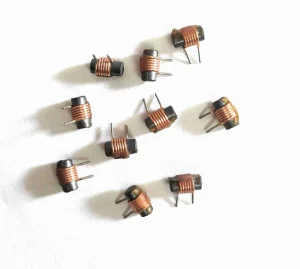
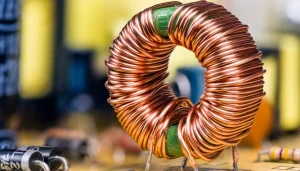
When choosing a transformer for applications such as audio systems, medical device, or industrial equipment, you’ll often compare toroidal transformers with E-I transformers.

Toroidal transformers feature a ring-shaped core, offering high efficiency, low noise, and reliable performance.
E-I transformers use an E- and I-shaped core, providing low cost, simple manufacturing, and reliable performance.
This guide compares toroidal transformers and E-I transformers to help you choose the right option for your application.
Core Design and Materials

Toroidal transformers use a ring-shaped core made of grain-oriented silicon steel. This design improves efficiency and reduces energy losses by maintaining a continuous magnetic flux path.
In contrast, E-I transformers use laminated steel sheets shaped like an “E” and “I.” This E-I transformer core design includes small air gaps, which can slightly reduce efficiency.
Meanwhile, both transformer types can use ferrite, powdered iron, or permalloy as core materials to meet the requirements of different transformer applications.
Efficiency and Energy Loss

Toroidal transformers typically achieve 90%–98% efficiency. Their closed-core design reduces magnetic losses, allowing them to run cooler and use less energy.
In contrast, E-I transformers typically operate below 90% efficiency. Higher flux leakage can also result in greater heat generation during operation.
Therefore, toroidal transformers can help reduce standby power consumption and lower long-term energy costs.
Noise and Vibration Performance

A major advantage of toroidal transformers is ultra-low hum noise. They hum far less than E-I transformers, up to eight times quieter. This makes them ideal for audio equipment and medical devices that require silent operation.
In comparison, E-I transformers can produce more vibration and noise due to their air gaps and magnetostriction, particularly under heavy loads.
Magnetic Fields and EMI Performance

Toroidal transformers can help reduce electromagnetic interference (EMI). Their closed-loop core helps contain magnetic fields, making them well suited for sensitive electronics.
For E-I transformers, more stray magnetic fields may be generated, which can require additional shielding near sensitive circuits, particularly in audio and data equipment.
Transformer Size, Weight and Installation

Toroidal transformers are compact and lightweight, often up to 50% smaller than E-I transformers with the same power rating. Their round shape and single-bolt mounting design make installation easier, especially in limited spaces.
For their part, E-I transformers have a larger and heavier design that requires multiple mounting bolts. However, their straightforward construction can make winding and repair work easier.
Inrush Current and Circuit Protection

Toroidal transformers can generate a high inrush current when powered on, sometimes reaching up to 80 times the rated current. To help protect circuits and connected components, a soft-start circuit or inrush current limiter is recommended.
E-I transformers, on the other hand, have lower inrush current due to their air gaps. This makes them easier to install without requiring additional protection circuits.
Cost, Efficiency and ROI

E-I transformers generally cost less and are easier to manufacture. Their open laminated core makes winding simpler and helps keep manufacturing costs lower.
Toroidal transformers require specialized winding machines and higher-quality core materials, which leads to a higher initial cost.
Over the long term, their high efficiency and low energy losses can help reduce operating costs and improve return on investment (ROI).
Power Ratings and Applications

Toroidal transformers are commonly used in applications up to 10–15 kVA. They are well suited for audio amplifiers, medical equipment, solar inverters, and other compact systems that require low noise and high efficiency.
E-I transformers can support much higher power ratings, making them ideal for industrial machinery, three-phase systems, and other heavy-duty applications where size is less of a concern.
Reliability and Durability

Toroidal transformers use tightly wound coils, which can place greater stress on the insulation and may increase the risk of internal shorts over time.
For E-I transformers, the greater space between windings allows them to accommodate thermal expansion more effectively. However, their structure can also make them more prone to vibration during operation. Using potting materials and thermal cycling tests can help improve the reliability of both transformer types.
| Feature | Toroidal Transformer | E-I Transformer |
|---|---|---|
| Core Design and Materials | Ring-shaped core, grain-oriented silicon steel, no air gaps | Laminated E-I core, visible air gaps, simple design |
| Efficiency and Energy Loss | 90–98% efficiency, lower energy loss, cooler operation | Below 90% efficiency, higher energy loss, runs hotter |
Noise and Vibration | Low noise and vibration, ideal for audio and medical equipment | More noise and vibration, better for general applications |
| Magnetic Fields and EMI | Low EMI, self-shielded design reduces interference | Higher stray magnetic fields, may need extra shielding |
| Size, Weight and Installation | Compact, lightweight, easy to install | Larger, heavier, needs more mounting space |
| Inrush Current and Protection | Higher inrush current, often requires a soft-start circuit or limiter | Lower inrush current, usually no extra protection needed |
| Production Cost and ROI | Higher production cost, better long-term ROI | Lower production cost, reduced material and labor costs |
| Power Capacity and Applications | Best for compact systems up to 10–15 kVA, ideal for audio and medical equipment | Supports higher power capacity, ideal for industrial and heavy-duty applications |
| Reliability and Durability | Higher stress on insulation, benefits from careful winding and potting | Better thermal expansion tolerance, but more prone to vibration |
How to Choose the Right Transformer

Not sure whether to choose a toroidal transformer or an E-I transformer? The right option depends on your application, budget, and performance requirements. Use this quick guide to narrow down your choice.
Need a lower cost?
Choose an E-I transformer. It has a lower price and is easier to manufacture.Need low noise?
Choose a toroidal transformer. Its low-noise operation makes it well suited for audio equipment and medical equipment.Working with limited space?
A toroidal transformer is compact and lightweight, making it a good fit for small enclosures.Need higher power?
An E-I transformer supports higher power ratings, making it suitable for industrial and heavy-duty applications.Concerned about inrush current?
An E-I transformer typically has lower inrush current, while a toroidal transformer usually requires a soft-start circuit or inrush limiter.Looking for better efficiency?
A toroidal transformer offers higher efficiency, lower energy losses, and cooler operation over time.Need easier installation and maintenance?
An E-I transformer is easier to install, wind, and service.
In the end, the right choice depends on your project requirements. Consider noise, cost, size, power ratings, and efficiency when evaluating your options. Choosing the right transformer type can help improve system reliability, reduce energy use, and deliver better long-term value.
Emerging Transformer Designs and Materials

Transformer technology continues to evolve, with new materials and designs improving the performance of both toroidal transformers and E-I transformers.
Nanocrystalline and MPP cores
Nanocrystalline and MPP cores can reduce energy loss and improve high-frequency performance. They are widely used in renewable energy systems, EV chargers, and compact power supplies.Hybrid laminations
Hybrid laminations combine silicon steel with amorphous metals to improve efficiency while helping lower manufacturing costs.Planar and PCB toroidal designs
Planar and PCB toroidal transformers offer compact solutions for high-voltage and high-frequency applications. They can help reduce product size in telecommunications, aerospace, and other advanced electronic systems.
With rising power demand and tighter space constraints, these transformer designs can support higher efficiency, lower energy loss, and improved overall performance. The continued development of transformer technology is opening up new possibilities for future applications.
Transformer Selection Guide

Whether you’re designing audio equipment, medical devices, or industrial systems, choosing the right transformer can help improve performance and reliability.
Contact us today for expert advice and customized transformer solutions tailored to your application, budget, and performance requirements.
FAQs About Toroidal vs EI Transformers
Which is better: a toroidal transformer or an E-I transformer? The best transformer choice depends on your application. Toroidal transformers offer higher efficiency, lower operating noise, and a compact design, making them well suited for audio equipment, medical devices, and space-saving systems. E-I transformers are more affordable and better suited to industrial and high-power applications.
What are the advantages of toroidal cores over E-I cores?
Toroidal cores provide several key advantages:
Higher efficiency and lower energy loss
Smaller size and lighter weight
Lower noise and less vibration
Reduced EMI and stray magnetic fields
What are the disadvantages of toroidal transformers?
Toroidal transformers also have some limitations:
Higher inrush current during startup
Higher production cost due to more complex winding
Usually limited to 10–15 kV
More difficult to repair if damaged
What is an EI transformer?
An E-I transformer uses a laminated steel core shaped like the letters “E” and “I.” Its simple design makes it easier to manufacture and wind. It is widely used in power supplies, industrial machinery, and lighting systems that require reliable voltage transformation.