


If you’re into high-quality audio, you’ve probably heard the term toroidal transformer tossed around. But what exactly is it—and why do so many high-end amplifiers use it?
A toroidal transformer is a type of power transformer with a round, donut-shaped core. Unlike traditional blocky designs, toroidal transformers are known for being more efficient, quieter, and better at reducing electrical noise.

That’s why they’ve become the go-to choice for audiophile amplifiers, studio gear, and premium sound systems. In this article, we’ll dive into what makes toroidal transformers special in audio applications—and why they might just be the upgrade your amplifier needs.
Why Toroidal Transformers Matter in Audio Amplifiers

When it comes to sound quality, every detail matters—and that includes your transformer. Toroidal transformers are a favorite in audio amplifiers because they deliver clean, stable power without adding unwanted noise or heat.
Here are the key reasons why toroidal transformers shine in audio applications:
Ultra-low hum and vibration
Their round core design reduces mechanical buzz and helps keep your sound crisp and clear—even at high volumes.Excellent EMI shielding
The closed magnetic path lowers stray fields, so your music stays free from background noise or interference.Higher efficiency with less heat
Toroids waste less power as heat, which means your amp runs cooler and lasts longer.Cleaner power delivery
Their low magnetic leakage ensures steady voltage and current, improving audio clarity and dynamic response.Compact and space-saving
Smaller than traditional transformers, they fit well into slim or portable amplifier enclosures.
In short, toroidal transformers help your amplifier deliver clean power, lower noise, and better performance—all in a smaller, more efficient package.
Improved Sound & Performance

Great sound isn’t just about the speakers—it starts with clean, reliable power. Toroidal transformers offer better voltage regulation, which helps your amplifier deliver stable performance even during power dips.
They also respond faster to quick changes in demand, giving you sharper detail and stronger dynamics. That means richer highs, deeper bass, and a more lifelike listening experience.
Comparisons with E‑I and R‑Core Transformers

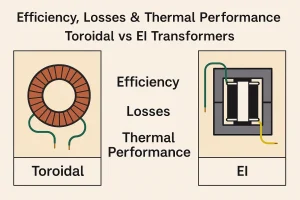
So how do toroidal transformers stack up against E‑I and R‑core types? The difference is clear—especially in audio.
Toroidal transformers are much quieter thanks to their closed-loop design, which reduces mechanical hum and electromagnetic interference. They’re also smaller and lighter, making them a great fit for compact amplifier designs.
Compared to E‑I cores, toroids offer more consistent build quality from unit to unit. And while R‑core transformers are also low-noise, toroids often provide better power efficiency and are easier to mount in tight spaces.
If you’re after clean sound and a compact build, toroidal is usually the better choice.
Practical Considerations for Design

Using a toroidal transformer in your audio amp? There are a few things to keep in mind.
Inrush current can be high at startup, so using a soft-start circuit or inrush limiter is a smart move.
For mounting, toroids are easy to install—usually with a single center bolt—but be sure it’s vibration-isolated.
Shielding is often built-in, but adding a metal screen can help in noisy environments.
Need something specific? Toroidal transformers can be customized for voltage, size, or shape, and many meet international IEC safety standards.
With the right setup, you’ll get the best performance without compromise.
Innovations & Future Trends

Toroidal transformers aren’t just great—they’re getting even better. New core materials like nanocrystalline and MPP (Molypermalloy Powder) are making transformers more efficient, with lower losses and better high-frequency performance. This means even cleaner power for your amp and more room for sound detail.
Designs are also getting smarter. Hybrid toroidal transformers and integrated models are being developed to fit into ultra-compact audio rigs, saving space without sacrificing quality. As audio tech keeps evolving, toroidal transformers are keeping up—quietly powering the next generation of sound.
Conclusion

Toroidal transformers are ideal for audiophile, studio, and compact amplifiers that need clean, quiet power. For budget builds or high-watt industrial gear, E-I or switch-mode options may be more practical.
Need help choosing the right transformer? Contact us today for expert advice and custom solutions.
FAQs
Do toroidal transformers sound better?
Many audiophiles believe toroidal transformers offer cleaner sound due to reduced magnetic interference and mechanical hum. They’re quieter and produce less EMI—though how much that actually improves audio can vary by context and equipment.
What are the disadvantages of toroidal transformers?
Toroids tend to cost more because winding requires specialized machinery. They also have high inrush current, limited maximum power (< 4–10 kVA), and are harder to repair than E‑I types.
Is a toroidal transformer good?
Yes—especially for audio applications. They are efficient, compact, quiet, and emit very low stray fields, making them ideal for sensitive gear needing clean, stable power.
How to choose a toroidal transformer?
Match input/output voltage and power (VA) to your device. Check operating frequency (50/60 Hz), temperature rise, size constraints, and mounting/shielding needs. For audio, consider silence, regulation, and IEC/UL certifications too.
 English
  Spanish
  Russian
  Italian
  German
  Chinese