


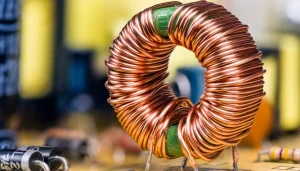
If you crack open today’s audio amp, solar inverter, or MRI scanner, you’ll likely spot a copper-wound “doughnut” instead of the bulky laminated block older transformers used. That sleek ring is a toroidal transformer.

Its closed-loop core guides magnetic flux with almost zero leakage, so designers get higher efficiency, a much smaller footprint, and whisper-quiet operation—all priceless in space-tight, noise-sensitive electronics.
Let’s see why this modern workhorse is replacing traditional rectangular cores across so many power-hungry applications.
What Is a Toroidal Transformer?

A toroidal transformer is a type of electrical transformer built around a donut-shaped core, typically made from ferrite, laminated silicon steel, or iron powder. Around this ring, two sets of insulated copper wire—the primary and secondary windings—are carefully wrapped. These windings are separated by insulation layers to prevent short circuits and ensure safety.
What makes this design special is its closed-loop magnetic path. Unlike square or E-I core transformers, a toroidal core allows the magnetic field to circulate efficiently within the core, resulting in minimal magnetic flux leakage. This not only boosts efficiency but also significantly cuts down electromagnetic interference (EMI)—making toroidal transformers a go-to choice for sensitive electronics like audio gear and medical devices.
What Are Toroidal Transformers Used For?

Toroidal transformers are widely used in various industries due to their compact design, low noise, and high efficiency. Here are the most common applications:
Medical Equipment
Used in MRI machines, defibrillators, and patient monitors for low noise and precise voltage control.Audio Systems
Deliver clean power with minimal hum, making them ideal for amplifiers, speakers, and high-fidelity audio gear.Industrial Automation
Power compact control panels and motors where space-saving and thermal efficiency are crucial.Telecom & IT
Offer low electromagnetic interference (EMI) and provide safe isolation for sensitive data systems and servers.Renewable Energy Systems
Power inverters and converters in solar and wind setups where efficiency and reliability matter most.Application-Specific Variants
Power Transformers – Step up/down voltage in power supplies
Isolation Transformers – Provide electrical isolation for safety
Audio Transformers – Match impedance and preserve signal clarity
How Does a Toroidal Transformer Work?

At the heart of every toroidal transformer is Faraday’s Law of Electromagnetic Induction. Sounds complex? Let’s break it down in simple terms.
When alternating current (AC) flows through the primary winding, it creates a changing magnetic field in the toroidal core—that donut-shaped loop made of ferromagnetic material like laminated iron or ferrite.
This changing magnetic field induces an electromotive force (EMF) in the secondary winding, which then delivers the transformed voltage to the output circuit.
Key Principles:
Turns Ratio Matters
The voltage output depends on the number of turns in the windings.More turns in the secondary → higher voltage (step-up).
Fewer turns → lower voltage (step-down).
Efficient Magnetic Flux Containment
The closed-loop design of toroidal cores means nearly all the magnetic flux stays inside the core, reducing leakage and boosting energy efficiency. That’s why toroids are often quieter and cooler than traditional transformers.Operating Frequencies & Core Materials
Low-frequency (50–400 Hz): use laminated steel or iron powder cores.
High-frequency (kHz to MHz): use ferrite cores for minimal loss and high performance.
Thanks to this clever design, toroidal transformers can efficiently transfer power while taking up less space and producing less noise. That’s a win for modern electronics!
Advantages and Disadvantages of Toroidal Transformers

Toroidal transformers aren’t just stylish with their doughnut-shaped cores—they bring real-world performance perks that make them ideal for many modern devices. But like anything, they come with trade-offs. Let’s break it down:
✅ Advantages
Toroidal transformers offer exceptional energy efficiency, running cooler and quieter than traditional types. Their compact, low-EMI design makes them ideal for space-sensitive and noise-sensitive applications like audio and medical devices. With minimal heat loss and a durable build, they’re reliable and long-lasting.
⚠️ Disadvantages
Despite their benefits, toroidal transformers can be more expensive due to complex manufacturing. They’re not suitable for three-phase systems and may require added protection because of high inrush current at startup.
FAQs About Toroidal Transformers
1. Why choose a toroidal transformer over a traditional one?
Toroidal transformers offer higher efficiency, quieter performance, and take up less space, making them a smart choice for modern electronics.
2. Can toroidal transformers be used in audio gear?
Absolutely! Their low hum and distortion make them perfect for high-fidelity audio equipment.
3. What materials are used in toroidal cores?
Common materials include ferrite, laminated iron, silicon steel, and advanced metals like amorphous alloys or nanocrystalline cores, depending on frequency and efficiency needs.
Conclusion

Toroidal transformers offer excellent efficiency, compact design, and low noise—making them ideal for sensitive electronics, medical gear, and energy systems. Their unique shape minimizes EMI and heat loss while maximizing performance.
Need a transformer that fits tight spaces and performs quietly? Contact us today to explore standard or custom toroidal transformer options tailored to your application.

 English
  Spanish
  Russian
  Italian
  German
  Chinese