


Bobine toroidali are widely used in applications such as transformers and inductors, where their design helps reduce interferenza elettromagnetica (EMI) and improve overall performance.

However, manually winding bobine toroidali can be a complex and time-consuming process.
UN DIY toroidal coil winding machine offers a practical alternative, helping achieve more consistent and accurate winding while reducing the need for manual work.
Componenti necessari per la macchina avvolgitrice toroidale fai da te

Before starting the build, let’s review the essential components you’ll need for a DIY toroidal coil winding machine.
- Controllore Arduino
- Motori passo-passo
- Motori a corrente continua
- Encoder rotativo e display LCD
- Cinghie dentate e pulegge
- Anello e supporti per rocchetti
- Miscellaneous Components
Guida passo passo per l'avvolgimento personalizzato della bobina
Fase 1: Progettare il telaio e l'assemblaggio

Begin by designing the base frame, roller holders, and ring assembly using compensato e profili in alluminio.
Make sure the frame is sturdy and stable enough to support the movement of the motorized components.
The design should also allow for easy adjustments during the toroidal coil winding process while keeping the nucleo toroidale securely in place.
Fase 2: Impostare i motori passo-passo e i motori CC

Securely mount the stepper motor and Motore a corrente continua to the frame.
The stepper motor controls the rotation of the nucleo toroidale, while the DC motor drives the spool.
For precise motion control, use NEMA 17 stepper motors. Connect both motors to the Arduino controller to coordinate their operation and adjust movement as needed.
Fase 3: installare le cinghie di distribuzione e le pulegge

Connect the timing belts to the motors and spool ring, making sure the pulleys are properly aligned for smooth operation.
Adjust the belt tension to prevent slippage during operation.
Proper belt tension is essential for avvolgimento preciso del filo. Make sure the belts are neither too tight nor too loose.
Passaggio 4: implementare il controller Arduino
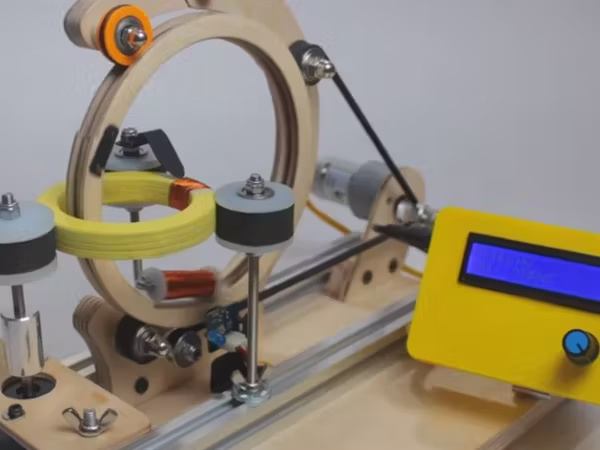
Connect the Arduino controller to both the stepper motor and DC motor. Program it to adjust the numero di giri, wire density, E rotation speed through the LCD display.
This setup allows you to adjust key winding parameters and customize the toroidal coil winding process to suit your needs.
Fase 5: Test e calibrazione
Run several wire winding cycles to test the machine’s operation.
Adjust the motor speeds and inspect the wire placement to ensure consistent winding.
If you notice issues such as belt slippage or misalignment, adjust the motor speeds, pulley alignment, and belt tension as needed to achieve smooth operation.
Fase 6: Ritocchi finali e considerazioni sulla sicurezza
Once the machine operates smoothly, install protective covers around moving parts and add rubber feet to keep the machine stable.
Make sure all components are securely fastened and double-check the wiring to help prevent accidents.
These final checks help ensure your DIY macchina avvolgitrice toroidale is safe, stable, and ready for use.
Errori comuni da evitare

Even a well-built DIY toroidal winding machine may not perform as expected if certain details are overlooked. Keep these common pitfalls in mind:
Calibrazione della tensione del filo di salto can result in uneven winding and wire breakage.
Cinghie eccessivamente strette can place extra strain on the motor and shorten its service life.
Trascurare le caratteristiche di sicurezza ,such as proper insulation, protective covers, and emergency stops, can increase the risk of accidents.
Careful planning and thorough checks can help you build a safer machine and achieve smoother operation.
Domande frequenti
1. A cosa serve una bobina toroidale?
UN bobina toroidale is commonly used in transformers, inductors, and chokes. Its ring-shaped design helps reduce interferenza elettromagnetica (EMI) and improve energy efficiency.
2. Come si avvolge una bobina toroidale?
To wind a bobina toroidale, pass the wire through the center of the core, wrap it around the outside, and pass it through the center again. Repeat this process until the required number of turns is reached.
3. Qual è il vantaggio di una bobina toroidale rispetto a una bobina normale?
The symmetrical design of bobine toroidali helps reduce magnetic flux leakage and electromagnetic interference. These characteristics make them suitable for use in sensitive electronic devices.
Conclusione

Building a DIY toroidal coil winding machine can simplify the winding process and help achieve more precise, consistent results.
Automation can make bobina toroidale production easier and more efficient, with output tailored to your specific needs.
Ready to get started? Follow this guide to build your own machine, or contattaci per ulteriori suggerimenti o soluzioni personalizzate!

 Italian
 English
 Spanish
 Russian
 German
 Chinese