


A toroidal transformer is a donut-shaped electrical device used to transfer power efficiently and quietly.

Its compact design, low electromagnetic interference (EMI), and minimal heat generation make it ideal for sensitive electronics.
These transformers are widely used in audio systems, medical devices, and energy-efficient power applications.
What Is a Toroidal Power Transformer?

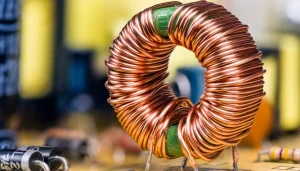
A toroidal power transformer uses a donut-shaped magnetic core with tightly wound coils for efficient energy transfer.
It’s compact, quiet, and ideal for sensitive electronics due to its low EMI and excellent thermal handling.
Key Advantages:
Compact and space-saving design
Low electromagnetic interference (EMI)
Quiet operation with minimal hum
High energy efficiency
Excellent heat dissipation
Ideal for sensitive or space-limited applications
How Does a Toroidal Transformer Work?

Toroidal transformers work on the principle of electromagnetic induction.
When AC flows through the primary winding, it creates a changing magnetic field inside the toroidal core. According to Faraday’s Law, this changing field induces a voltage in the secondary winding.
The core’s circular shape efficiently contains magnetic flux, minimizing leakage.
Because the windings wrap tightly around the entire core, it allows shorter coils, full core utilization, and low energy losses.
The turns ratio between windings controls voltage: more turns in the secondary = step-up; fewer = step-down.
Compared to solenoid-core designs, toroids reduce EMI, noise, and size.
Though they can produce higher inrush current, it’s managed using thermistors or active limiters.
Losses include copper, core, stray, and dielectric.
Applications of Toroidal Transformers

Toroidal transformers are trusted across many industries thanks to their quiet performance, low electromagnetic interference, and space-saving design.
Here’s where they shine:
Audio Equipment: Ideal for amplifiers, preamps, and studio gear. Their low noise and distortion make them a top choice for sound-sensitive setups.
Medical Devices: Perfect for MRI machines, monitors, and diagnostic tools, where low leakage current and compactness are essential.
Industrial Control Systems: Common in automation panels and sensors, offering stable power in rugged environments.
Renewable Energy: Used in solar and wind inverters to ensure efficient power transfer with minimal heat.
Consumer Electronics: Found in TVs, computer power supplies, gaming systems, and high-performance chargers for reliable energy delivery.
Conclusion

Toroidal transformers offer compact size, high efficiency, low EMI, and whisper-quiet performance, making them ideal for modern electronics and sensitive systems.
Looking to upgrade your power solution? Contact us today to find the right toroidal transformer for your next project.
FAQs
What is the purpose of a toroidal transformer?
A toroidal transformer transfers electrical energy between circuits with minimal noise and energy loss. It’s commonly used in compact, efficient, and sensitive electronic devices.
What are the disadvantages of toroidal transformers?
They’re more expensive to manufacture due to complex winding processes and are not ideal for three-phase applications or high-power systems.
What is the difference between a toroidal transformer and a normal transformer?
Toroidal transformers use a circular core for better efficiency, low EMI, and compact size, while traditional transformers use laminated rectangular cores that are bulkier and less efficient.
What is the purpose of a toroid?
A toroid shapes the magnetic field in a closed loop, reducing flux leakage and interference. It’s ideal for compact, low-noise magnetic applications like inductors and transformers.

 English
  Spanish
  Russian
  Italian
  German
  Chinese