


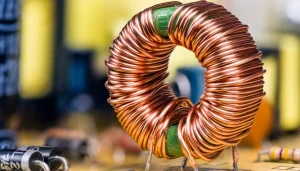
Trasformatori toroidali feature a compact doughnut-shaped core design that provides excellent magnetic efficiency and balanced performance. This closed-loop structure helps reduce stray magnetic fields, lower audible noise, and improve energy transfer compared with tradizionale laminato core transformers.
The symmetrical design also supports more even avvolgimento del trasformatore distribution, helping reduce leakage, minimize interferenza elettromagnetica (EMI), and achieve more stable, reliable operation.

Trasformatori toroidali sono comunemente usati in apparecchiatura audio, dispositivi medici, E alimentatori, where clean power delivery, compact design, and quiet operation are important. A well-designed trasformatore toroidale improves efficiency, reliability, and overall performance by optimizing core materials, structure, and transformer winding methods.
Toroidal Transformer Benefits

Trasformatori toroidali are widely valued for their dimensioni compatte, lightweight design, E alta efficienza (often reaching Efficienza 90–95%). Their nucleo ad anello usi copper space more effectively, helping improve transformer performance while maintaining a smaller, more efficient structure. This makes them well suited for compact systems E space-limited applications.
Another major advantage of trasformatori toroidali è loro low audible noise E reduced stray magnetic fields. The balanced transformer winding design intorno a un anima in acciaio a grani orientati helps maintain magnetic flux control, ridurre interferenza elettromagnetica (EMI), and support stable operation—making them ideal for sensitive applications such as dispositivi medici E attrezzatura audio
Toroidal Transformer Core Design

The core of a trasformatore toroidale è tipicamente fatto da acciaio al silicio a grani orientati, which provides low core loss and strong magnetic performance. Regolando il rapporto diametro-altezza of the nucleo toroidale, designers can create lower-profile designs with larger diameters or achieve higher densità di potenza with taller core structures.
To achieve better toroidal transformer efficiency, engineers often target an optimal core ratio Dove perdite di rame are around 60% of ferro losses. This balance helps improve trasferimento di energia, maintain lower operating temperatures, and support more reliable transformer performance. Selecting the right geometria del nucleo E transformer materials from the beginning provides a strong foundation for a durable, high-performance design.
Toroidal Transformer Design Calculations

Designing a trasformatore toroidale starts with the fundamentals of Legge di Faraday. This principle determines the required number of wire turns needed to generate the desired tensione di uscita and achieve efficient transformer performance:
Induttanza is the next key factor, calculated based on the core outer diameter (OD), diametro interno (ID), altezza, E material permeability. Selecting the right toroidal transformer core dimensions helps maintain alta efficienza while reducing potential losses.
Designers also consider the prodotto di area (Ap), an important parameter that combines dimensione del nucleo E winding space. IL Ap value helps balance core dimensions, winding area, E densità di potenza, while also considering limiti termici to ensure the trasformatore operates with stable temperature and reliable performance.
Winding Design & Leakage Control

Bene progettazione dell'avvolgimento is just as important as proper toroidal transformer core design. A uniform transformer winding distribution around the toroid helps minimize induttanza di dispersione E interferenza elettromagnetica (EMI). This balanced winding layout reduces stray magnetic fields, improves efficienza energetica, and supports more stable performance, especially in sensitive electronic applications.
Per high-performance toroidal transformers, windings may be arranged in carefully planned sections to control leakage effects and achieve specific filtering performance. This approach helps fine-tune the transformer’s response, improving stability and making it better suited for its intended application.
Simulation-Based Performance Optimization

Moderno progettazione del trasformatore toroidale benefits greatly from Finite Element Method (FEM) modeling. This simulation method allows engineers to visualize distribuzione del flusso magnetico, identificare percorsi di perditae valutare come core geometry changes affect performance before building a prototype.
Beyond simulation, designers can further improve performance through automated design optimization. Regolando il fattore di riempimento (copper-to-window area ratio) and Y/Z geometric ratios, engineers can achieve a better balance between efficienza, transformer weight, E gestione termica. These techniques, based on NASA design research, help create accendino, più frescoe altro ancora reliable transformers.
High-Frequency Transformer Considerations

Per high-frequency transformer designs, selezione dei materiali plays a critical role. Traditional grain-oriented steel cores are suitable for low-frequency power applications, Mentre nuclei di ferrite provide lower losses for wide-band pulse applications E switching power supplies.
In systems such as SMPS E Convertitori basati su GaN/SiC, engineers must carefully manage induttanza di dispersione ad alta frequenza E capacità parassita. Excessive capacitance can create unwanted resonances, while poor leakage control may reduce transformer efficiency. Achieving stable performance requires precise winding layouts and, when needed, additional schermatura O insulation techniques to maintain reliable operation.
Practical Design Challenges & Trade-Offs

Designing a trasformatore toroidale involves more than calculations—it also requires solving practical manufacturing challenges. Winding complexity is a key issue because the wire must repeatedly pass through the center of the nucleo toroidale, often requiring specialized tooling. Careful lead routing is also needed to avoid strain and unwanted coupling effects.
Another important factor is balancing transformer size and efficiency. A smaller core design can reduce weight and material costs but may increase perdite di rame due to thinner wire. In applications like portable equipment E sistemi aerospaziali, engineers may accept this trade-off to achieve a lighter, more compact progettazione del trasformatore.
Essential Tools & Design References

If you’re designing a trasformatore toroidale, using the right design tools and technical references can help improve accuracy and reduce development time. Traditional transformer design formulas from industry handbooks, along with NASA’s early toroid design software, remain useful starting points for calculating key parameters. Today’s simulation software can further simplify the process by helping engineers optimize turns calculation, flux density, E prestazioni termiche with less trial and error.
Per un apprendimento più approfondito, risorse come Manuale di progettazione di trasformatori e induttori e specializzato produttore design guides provide proven methods and practical insights. Combining these design references with hands-on testing helps create efficiente, reliable, and practical transformer designs.
Bring Your Transformer Ideas to Life

Se hai bisogno trasformatori toroidali progettati su misura, transformer design optimization, O technical troubleshooting support, our team is ready to assist. We combine engineering expertise con precision manufacturing to provide solutions that match your prestazione, costo, E reliability requirements.
Contattaci oggi to discuss your project, request a quote, or explore transformer design solutions. Let’s turn your transformer ideas into efficient, reliable, and practical solutions.
Domande frequenti
1.How to design a toroidal transformer?
Inizia con Legge di Faraday to calculate the required Campo elettromagnetico, then determine key parameters such as giri, power rating, operating frequency, E duty cycle. Utilizzo core dimensions E material data to size the transformer properly, while considering aumento della temperatura to ensure stable operation.
2. Quali sono gli svantaggi dei trasformatori toroidali?
Mentre trasformatori toroidali offer high efficiency and compact designs, they also come with some trade-offs:
Higher manufacturing cost due to complex production processes and premium materials
Capacità di potenza limitata, as they are typically not suitable for high-power applications above ~4 kW
Core fragility, since the core material can be brittle and have low thermal expansion, making it more vulnerable to damage
Corrente di spunto più elevata, which may trigger fuses or affect connected components if not properly managed
3. I trasformatori toroidali suonano meglio?
Trasformatori toroidali can help deliver cleaner audio performance with lower hum E electrical noise, making them a popular choice in sistemi audio. Their closed-core structure and tightly wound design help reduce EMI (electromagnetic interference) and vibration. However, overall sound quality also depends on the complete system design and the quality of other components.
4. Qual è il progetto di trasformatore più efficiente?
Maximum transformer efficiency is achieved by balancing perdite di rame E perdite di ferro. Per trasformatori toroidali, the optimal design principle is often based on keeping copper losses at around 60% of iron losses.
Moderno transformer designs can achieve Efficienza 98% o superiore, especially when using advanced materiali di base ad esempio anime di acciaio amorfo to reduce core losses. The most efficient design ultimately depends on materiali di base, progettazione dell'avvolgimento, and actual condizioni operative.

 Italian
  English
  Spanish
  Russian
  German
  Chinese