


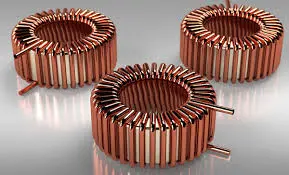
When you open a modern audio amplifier, solar inverter, or MRI scanner, you may find a copper-wound transformador toroidal rather than the bulky laminated-core transformers used in older equipment. Its distinctive ring-shaped design gives it the familiar doughnut-like appearance.

Its closed-loop core design helps contain magnetic flux and reduce leakage, allowing transformadores toroidales to offer high efficiency, a compact footprint, and quiet operation. These characteristics make them well suited to electronic equipment where space and noise levels are important considerations.
Let’s explore why transformadores toroidales are increasingly used as an alternative to traditional rectangular-core designs in a wide range of power applications.
¿Qué es un transformador toroidal?

A transformador toroidal is is an electrical transformer built around a donut-shaped core, typically made of ferrito, acero al silicio laminado, o polvo de hierro. Two sets of insulated copper wire, known as the devanados primarios y secundarios, are wound around the core. Insulation layers separate the windings to prevent short circuits and ensure safe operation.
What sets this design apart is its trayectoria magnética de bucle cerrado. Unlike square-core or E-I core transformers, a toroidal core allows magnetic flux to circulate efficiently within the core, resulting in fuga mínima de flujo magnético. This helps improve efficiency while reducing interferencia electromagnética (EMI), making transformadores toroidales a suitable choice for sensitive electronic equipment, including audio devices and medical equipment.
¿Para qué se utilizan los transformadores toroidales?

Transformadores toroidales are widely used across various industries thanks to their Diseño compacto, low noise levels, y Alta eficiencia. Some of their most common applications include:
Equipo medico
It supports máquinas de resonancia magnética, defibrillators, and patient monitors, delivering low noise levels y control preciso de voltaje for reliable operation.Sistemas de audio
It supplies energía limpia con zumbido mínimo for amplifiers, speakers, and high-fidelity audio equipment.Automatización industrial
Used in compact control panels and motor systems, where eficiencia espacial y rendimiento térmico are important considerations.Telecomunicaciones y TI
Used in sensitive data systems and servers, where baja interferencia electromagnética (EMI) y reliable electrical isolation are important.Sistemas de energía renovable
Found in power inverters and converters for solar y wind energy systems, dónde eficiencia y confiabilidad son esencialesVariantes específicas de la aplicación
Transformadores de poder – Step up or step down voltage in power supply systems.
Transformadores de aislamiento – Provide aislamiento eléctrico for safety.
Audio Transformadores – Match impedance while maintaining signal clarity.
¿Cómo funciona un transformador toroidal?

At the core of every transformador toroidal es Ley de inducción electromagnética de Faraday. Although the principle may sound complex, it is easy to understand when broken down into a few simple steps.
Cuando corriente alterna (CA) fluye a través de la devanado primario, it generates a campo magnético cambiante within the toroidal core.This ring-shaped core is made of ferromagnetic materials such as hierro laminado o ferrite.
The changing magnetic field induces an fuerza electromotriz (EMF) en el devanado secundario, generating the transformed voltage that is then supplied to the output circuit.
Principios clave:
La relación de vueltas importa
The output voltage depends on the number of turns in the primary and secondary windings.More turns in the secondary winding result in a higher output voltage (step-up).
Fewer turns in the secondary winding result in a lower output voltage (step-down).
Contención eficiente del flujo magnético
The closed-loop design of a núcleo toroidal keeps most of the magnetic flux within the core, helping reduce flux leakage and improve energy efficiency.This is one reason transformadores toroidales often operate more quietly and at lower temperatures than transformadores tradicionales.Frecuencias de operación y materiales del núcleo
Baja frecuencia (50–400 Hz): Laminated steel or iron powder cores are commonly used.
Alta frecuencia (kHz a MHz): Ferrite cores are preferred for their low core losses and high-frequency performance.
With this design, transformadores toroidales can transfer power efficiently while requiring less space and producing less noise, making them suitable for a wide range of modern aplicaciones electronicas.
Ventajas y desventajas de los transformadores toroidales

Transformadores toroidales offer several practical advantages thanks to their doughnut-shaped cores, making them suitable for a wide range of modern electronic applications. However, they also have some limitations. Here is a closer look at their key advantages and disadvantages:
✅ Ventajas
Transformadores toroidales oferta high energy efficiency and typically operate more quietly and at lower temperatures than traditional transformer designs. Their tamaño compacto y baja interferencia electromagnética (EMI) make them well suited to space- and noise-sensitive applications, such as audio equipment and medical devices. With low heat loss y un durable construction, they can also provide reliable, long-term operation.
⚠️ Desventajas
Despite these benefits, transformadores toroidales can be más caro to manufacture due to their complex production process. They are also No apto para sistemas trifásicos y puede requerir additional protection to manage the high inrush current that can occur during startup.
Preguntas frecuentes sobre transformadores toroidales
1. ¿Por qué elegir un transformador toroidal en lugar de uno tradicional?
Transformadores toroidales oferta higher energy efficiency, quieter operation, and a more compact design than many traditional transformer types. These features make them a suitable choice for a wide range of modern electronic applications.
2. Can toroidal transformers be used in audio equipment?
Yes. Their low hum y minimal electromagnetic interference (EMI) make them well suited to equipo de audio de alta fidelidad, where quiet operation and sound quality are important.
3. ¿Qué materiales se utilizan en los núcleos toroidales?
Común núcleo toroidal materiales incluir ferrite, laminated iron, y acero al silicio. Advanced materials, such as aleaciones amorfas y nanocrystalline materials, may also be used depending on the operating frequency and efficiency requirements.
Conclusión

Transformadores toroidales combinar high energy efficiency, a Diseño compacto, y funcionamiento silencioso, making them suitable for sensitive electronic equipment, medical devices, and energy systems. Their distinctive ring-shaped cores help reduce interferencia electromagnética (EMI) y heat loss, supporting efficient operation.
Looking for a transformer that fits limited installation space and operates quietly? Contáctenos hoy to discuss standard and custom toroidal transformer options for your application.

 Spanish
 English
 Russian
 Italian
 German
 Chinese