


How a Coil Winding Machine Works

At its core, a maquina bobinadora de bobinas is designed to wind wire into precise coils for transformers, motors, inductors, and other electronic components. It places wire evenly around a bobbin or core while maintaining controlled tension, ensuring stable performance and long-term reliability.
Accurate winding helps reduce electrical losses, improve coil consistency, and enhance product quality. Today, different types of máquinas de bobinado are available to meet various coil shapes, materials, and manufacturing requirements.
Tipos de máquinas bobinadoras
Bobinadoras de folletos – A wire guide rotates around a fixed bobbin to create precise bobinado. They are widely used for motor y devanado del transformador.
Lathe (shaft) winders – The bobbin rotates while the wire guide moves back and forth to build even coil layers. They are ideal for standard cylindrical coils.
Bobinadores toroidales – A wire shuttle passes through núcleos en forma de anillo. reating accurate windings for transformadores toroidales y inductores. They are ideal for compact, high-eficiencia designs.
Bobinadora transversal – A precision wire guide controls wire placement across the core. They are commonly used for fine wire winding y bobinado ortocíclico with a high factor de llenado.
Estos maquina bobinadora de bobinas types form the foundation of modern Tecnología de bobinado de bobinas. Their continued development has led to today’s CNC y programable systems,, delivering higher precision, better efficiency, and more flexible production.
From Manual Winding to Flyer Winders

The earliest máquinas de bobinado were simple and mostly manual. Operators guided the wire by hand while turning the bobbin with a crank or basic motor. Some machines included mechanical turn counters, but winding accuracy still relied on the operator’s skill and experience.
Bobinadoras de folletos were an early step toward automated bobinado. Instead of rotating the bobbin, the wire guide (flyer) moved around a fixed core, making devanado faster and more consistent for transformadores y bobinas de motor. However, the process still depended on operator skill, so winding accuracy could vary.
Although these early métodos de bobinado were a major step forward, they still had several limitations:
Baja precisión – Uneven wire layering often reduced rendimiento de la bobina and consistency
Calidad dependiente del operador – Coil quality relied on operator skill, making consistent production difficult.
Baja productividad – Manual wire guiding limited production speed and was unsuitable for large-scale manufacturing.
As a result, these challenges drove the development of more accurate máquinas de bobinado. This led to semiautomático systems and later CNC-controlled machines, delivering higher precision and better production efficiency.
Programmable Winding (1970s–1990s)

A finales del siglo XX, Tecnología de bobinado de bobinas advanced rapidly with motores paso a paso, PLC, and early microcontrollers. These innovations allowed winding recipes to store settings such as vueltas, paso, dwell, y traverse patterns, making bobinado more accurate and automated. This progress also paved the way for semiautomático and later CNC-controlled machines.
With these improvements, máquinas de bobinado could repeat the same winding cycle with greater consistency instead of relying only on operator skill. tensores electrónicos replaced traditional friction pads, providing better control de tensión del cable. This change improved productivity, produced more consistent bobinas, and reduced material waste compared with manual or bobinado de volante methods.
The CNC Era (2000s–Present)

En la década de 2000, CNC (Control Numérico por Computadora) brought a major upgrade to coil winding.Multi-axis servo drives synchronized the huso, traverse, y payoff units for precise wire placement. This enabled bobinado ortocíclico with minimal gaps, helping produce compact, high-density coils with greater Precisión y consistencia.
As technology advanced, this level of CNC control made it possible to produce multi-section coils, bobinas toroidales, y otros specialty windings that were once difficult to manufacture. It also increased eficiencia de producción, reducido scrap, and delivered excellent repeatability, making Máquinas bobinadoras CNC the preferred choice for EV motors, aeroespacial, y medical electronics.
Evolution of Wire Tension Control

Wire tension control became more advanced as máquinas de bobinado improved. Early machines used friction pads or dancer arms, but these systems could easily lose accuracy over time. Modern machines use retroalimentación de bucle cerrado de celda de carga to monitor tensión del cable in real time and automatically adjust braking or feed torque for more stable, consistent winding.
With these refined tension features, advanced wire tension control provides better wire protection, higher coil density, and consistent repeatability in every production run. Combined with CNC precision, it helps produce coils that are more durable y electrically efficient.
Toroidal Winding Technology

Bobinadora de transformadores toroidales de escritorio JG 6504
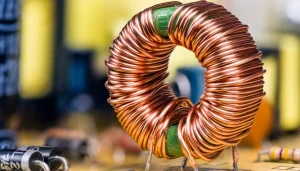
Como coil technology advanced, máquinas de bobinado toroidales were developed for núcleos en forma de anillo that traditional flyer or lathe winders could not handle. Early machines used shuttle systems to feed the wire through the core. This method worked well but offered relatively slow velocidad de bobinado.
Con el tiempo, máquinas de bobinado toroidales evolved into programmable y CNC-controlled systems, offering more accurate pitch control, automatic taping, y más alto velocidad de producción. Today, they are widely used in transformadores, EV power systems, equipo de audio, y dispositivos médicos, where compact, low-noise bobinas son esenciales
Integración de la Industria 4.0
Building on these advances, the latest máquinas de bobinado have entered the Industry 4.0 era with smarter production features, including:
Conectividad MES for seamless factory integration
Digital recipe management and production logs for consistent bobinado
Monitoreo y diagnóstico remoto to reduce downtime and improve efficiency
Real-time analytics help operators detect defects early and adjust machine settings quickly. This improves production yield, supports full production traceability, and keeps bobinado more consistent.
Perspectivas de futuro
Looking ahead, máquinas de bobinado will become smarter, faster, and more sustainable with technologies such as:
sistemas de visión de IA to predict and prevenir defectos antes de que ocurran.
Gemelos digitales to simulate bobinado patterns, speed up setup, and reduce trial runs.
Cobots (robots colaborativos) to automate loading and unloading for higher productivity.
Energy-efficient drives and lower scrap to reduce waste and improve energy efficiency.
These innovations will help máquinas de bobinado meet the growing needs of modern industries, including energía renovable, vehículos eléctricos (VE), and advanced manufacturing.
¿Está listo para actualizar su bobinado?

El desarrollo de máquinas de bobinado has transformed the industry, from manual flyer winders to CNC y Industry 4.0 systems. Whether you need higher winding accuracy, greater productivity, or smarter automation, choosing the right maquina bobinadora de bobinas can make a big difference.
Contáctenos hoy today for expert advice, reliable maquina bobinadora de bobinas solutions, and options tailored to your manufacturing needs. Let’s improve eficiencia de producción, reduce scrap, and build a smarter, more reliable production line together.

 Spanish
  English
  Russian
  Italian
  German
  Chinese